


Table of Contents
Why Indian Spices Are in High Demand Worldwide: Indian spices have shaped global trade routes, influenced culinary traditions, and driven economic exchange for centuries. From ancient maritime trade to modern container shipping, India has remained at the center of the global spice market. Today, Indian spices are in high demand worldwide not just for flavor, but for quality, medicinal properties, and supply reliability.
This article examines why Indian spices dominate global markets, what differentiates them from competitors, and whether this demand is sustainable in the long term.
Why Indian Spices Are in High Demand Worldwide
India: The Historical Epicenters of the Spice Trade | Why Indian Spices Are in High Demand Worldwide
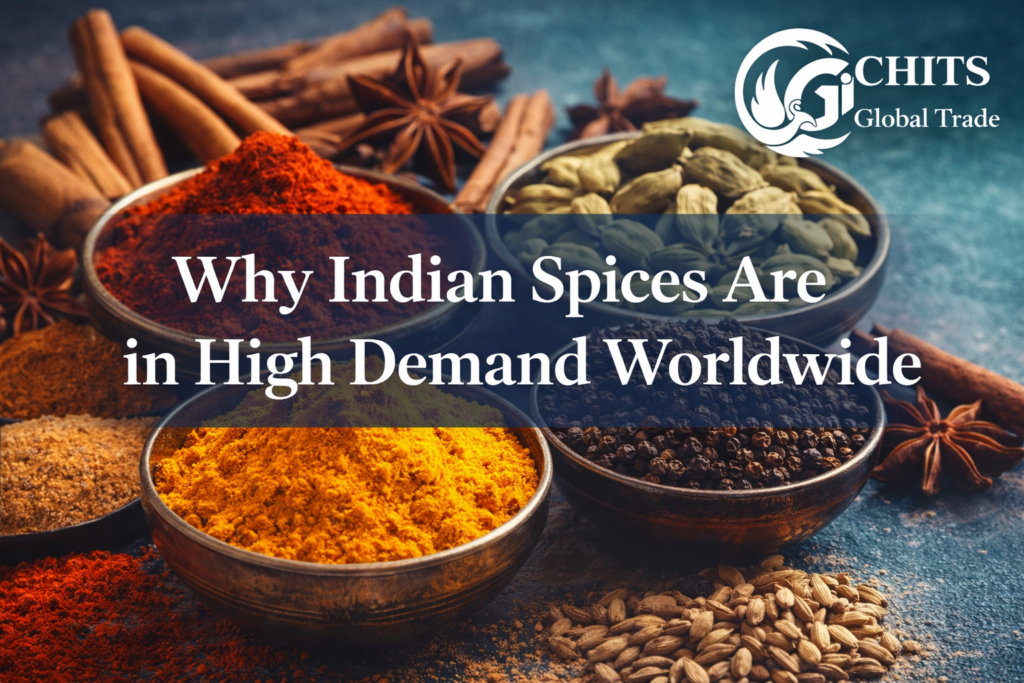
India’s spice trade dates back over 4,000 years. Ancient civilizations in Rome, Egypt, and China sourced pepper, cardamom, cinnamon, and turmeric from Indian ports.
Regions like Kerala, Tamil Nadu, Karnataka, and Rajasthan developed Agro-climatic advantages that allowed diverse spice cultivation. The term “Spice Route” itself is historically linked to India’s maritime trade networks.
This historical legacy still influences buyer perception. “Indian origin” in spices often signals authenticity and heritage a powerful intangible brand advantage.
India’s Global Position in the Spice Market | Why Indian Spices Are in High Demand Worldwide
India is among the world’s largest producers, consumers, and exporters of spices. It exports over 200 varieties of spices and spice products to more than 150 countries.
Major importing markets include:
- United States
- European Union
- Middle East
- China
- Southeast Asia
Key exported spices include:
- Black pepper
- Turmeric
- Chili powder
- Cumin
- Cardamom
- Coriander
India’s spice exports generate billions in annual revenue and form a critical segment of the agricultural export economy.
1. Unmatched Variety and Climatic Advantage
One reason Indian spices are in high demand worldwide is Agro-climatic diversity.
India’s geography allows cultivation across:
- Tropical coastal regions
- Semi-arid zones
- High-altitude hills
This enables production of both heat-intensive spices (like chili) and delicate aromatic varieties (like cardamom and saffron).
Few countries can match this range within a single national territory. This diversity strengthens India’s bargaining power in global trade.
However, this advantage is vulnerable to climate variability. Erratic rainfall and temperature fluctuations could impact long-term supply consistency.
2. Superior Flavor Profile and Essential Oil Content
Indian spices are known for:
- High essential oil concentration
- Strong aroma
- Deep color intensity
- Rich flavor complexity
For example:
- Indian turmeric is prized for high curcumin content.
- Malabar pepper has strong pungency.
- Guntur chilies are globally recognized for vibrant color and heat balance.
This sensory superiority creates premium demand in global food processing, pharmaceuticals, and nutraceutical industries.
Yet, quality variation across regions and smallholder farms can affect consistency an issue buyers monitor closely.
3. Growing Global Demand for Ethnic and Functional Foods
The global food industry is shifting toward:
- Ethnic cuisines
- Health-focused ingredients
- Plant-based diets
Indian spices are central to Asian, Middle Eastern, and fusion cuisines. Additionally, health-conscious consumers increasingly demand spices with anti-inflammatory and antioxidant properties.
Turmeric, for example, has seen explosive global demand due to its perceived medicinal benefits.
This demand is not limited to restaurants; it extends to:
- Ready-to-eat meals
- Spice blends
- Nutraceutical supplements
- Functional beverages
India benefits because it can supply both raw spices and processed blends.
4. Strong Export Ecosystem and Institutional Support
The Spices Board India plays a central role in promoting, regulating, and certifying Indian spice exports.
Its responsibilities include:
- Quality control
- Export certification
- Market development
- Branding initiatives
This institutional framework enhances trust among international buyers.
However, regulatory compliance is becoming stricter globally. Pesticide residue levels and food safety standards are closely monitored in markets like the EU and US. Continuous upgrading of compliance systems remains essential.
5. Competitive Pricing and Production Scale
India benefits from:
- Large-scale cultivation
- Labor-intensive farming model
- Established export networks
This allows competitive pricing in bulk markets without compromising on quality.
Yet, pricing advantage should not be confused with value advantage. Countries like Vietnam and Indonesia compete aggressively in certain spice categories. Sustained demand will depend on branding and quality differentiation, not just cost competitiveness.
6. Value-Added Spice Products and Processing Growth
India is increasingly exporting:
- Spice oils and oleoresins
- Blended seasonings
- Ready-to-use spice pastes
- Organic spice variants
Value addition improves margins and reduces dependence on raw commodity pricing cycles.
Global food companies prefer processed inputs rather than raw produce. Expanding processing capacity will determine whether India moves up the value chain.
7. Rise of Organic and Sustainable Farming
Global buyers are demanding traceable, pesticide-free produce. India has expanded organic spice cultivation, particularly in:
- Turmeric
- Ginger
- Pepper
Organic certification increases export potential in premium markets.
However, organic farming requires strict supply chain traceability. Scaling organic production while maintaining authenticity remains a logistical challenge.
8. Strong Diaspora and Culinary Influence
Indian diaspora communities across the UK, US, Canada, Australia, and the Middle East sustain steady demand for authentic spices.
Beyond diaspora demand, Indian cuisine has entered mainstream global dining culture. Restaurants, cooking shows, and food influencers have popularized spice-heavy recipes worldwide.
This cultural diffusion creates structural demand that is unlikely to decline.
Challenges That Could Affect Future Demand | Why Indian Spices Are in High Demand Worldwide
While demand is strong, several risks exist:
- Climate change impacting yields
- Rising global competition
- Food safety compliance issues
- Price volatility
- Supply chain disruptions
If India does not continue upgrading quality standards and logistics infrastructure, competitors may capture market share.
Economic Impact of Spice Exports
Spice exports contribute significantly to:
- Rural farmer incomes
- Foreign exchange reserves
- Agro-processing industry growth
- MSME sector expansion
Smallholder farmers form the backbone of spice production. Export growth directly affects livelihoods in southern and northeastern India.
Yet, ensuring equitable distribution of export profits across the value chain remains a policy priority.
The Future of Indian Spices in Global Markets
Demand trends suggest continued growth driven by:
- Health-conscious consumers
- Expansion of global cuisines
- Growth in processed foods
- Rising interest in natural ingredients
For India to maintain leadership, it must:
- Invest in quality certification
- Strengthen cold storage and logistics
- Expand value-added processing
- Improve traceability systems
- Build stronger global branding
The global spice market is competitive and dynamic. Sustained dominance will depend not only on heritage, but on innovation and consistency.
Frequently Asked Questions (FAQs) | Why Indian Spices Are in High Demand Worldwide
1. Why are Indian spices so popular worldwide?
Indian spices are popular globally because of their rich aroma, strong flavors, natural quality, and long history in traditional cooking. They are also widely valued for their medicinal and health benefits.
2. Which Indian spices are in highest demand globally?
Some of the most in-demand Indian spices include turmeric, black pepper, cumin, cardamom, chili, coriander, ginger, and cinnamon.
3. Are Indian spices considered healthy?
Yes, Indian spices are known for their health benefits. Many have anti-inflammatory, antioxidant, and digestive properties and are widely used in Ayurveda and natural medicine.
4. Why do Indian spices dominate the global spice market?
India has favorable climatic conditions, diverse soil types, traditional farming expertise, and large-scale production capabilities, making it one of the world’s largest producers and exporters of spices.
5. Which countries import the most Indian spices?
Major importers of Indian spices include the United States, United Kingdom, Germany, UAE, Saudi Arabia, China, and other European and Middle Eastern countries.
6. How does the quality of Indian spices compare to others?
Indian spices are known for their superior quality, high essential oil content, strong flavor, and strict quality control standards, which makes them highly competitive in global markets.
Conclusion | Why Indian Spices Are in High Demand Worldwide
Indian spices are in high demand worldwide because of their unmatched variety, strong flavor profiles, health benefits, competitive pricing, and institutional support. Historical legacy combined with modern export infrastructure has positioned India as a dominant player in the global spice trade.
However, leadership is not guaranteed. Climate pressures, global competition, and rising quality expectations require strategic adaptation.
India’s spice industry has deep roots but its future success will depend on how effectively it modernizes while preserving the authenticity that made it globally renowned.