


In global sourcing, price is often the first thing buyers look at. A lower quote feels like a win immediate savings, better margins, and a competitive advantage.
But here’s the uncomfortable truth: cheap suppliers cost more in the long run.
Many businesses learn this only after facing delays, defective products, or unexpected expenses that wipe out their initial savings.
At chitsglobaltrade, we’ve seen this pattern repeatedly. Buyers choose the lowest-priced supplier expecting to save money, only to end up dealing with quality issues, operational disruptions, and financial losses.
This blog explains why focusing only on price is a costly mistake and what smart importers do differently.
The Illusion of Low Prices
At first glance, a cheaper supplier looks like a smart decision. cheap suppliers cost more in the long run.
Let’s say:
- Supplier A quotes $5 per unit
- Supplier B quotes $6.20 per unit
Most buyers instinctively choose Supplier A.
But what they don’t see are the hidden risks behind that lower price:
- Lower-grade materials
- Inconsistent production standards
- Lack of quality checks
- Poor communication
That $1.20 saving per unit can quickly turn into thousands in losses.
This is exactly why cheap suppliers cost more in the long run — because price does not reflect total cost.
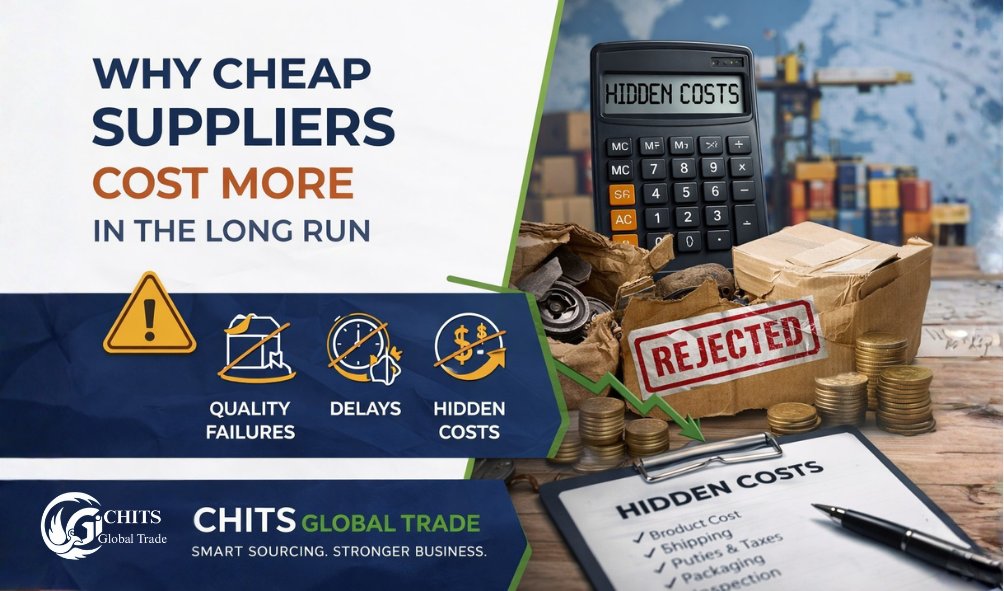
Hidden Costs That Destroy Your Margins
The biggest mistake importers make is ignoring hidden costs.
Here are the most common ones:
1. Quality Failures
Cheap suppliers often cut corners to reduce costs.
This leads to:
- Defective products
- Inconsistent batches
- Customer complaints
Replacing or refunding faulty products can cost far more than the initial savings.
2. Shipping Delays
Low-cost suppliers may:
- Miss deadlines
- Overcommit production
- Lack proper planning
Delays can result in:
- Lost sales
- Emergency shipping costs
- Damaged business relationships
Time is money in global trade. cheap suppliers cost more in the long run.
3. Rework and Replacement Costs
If products don’t meet quality standards, you may need to:
- Reorder
- Repair
- Repackage
These additional costs quickly erase any price advantage.
4. Communication Gaps
Cheap suppliers often have:
- Poor responsiveness
- Language barriers
- Lack of accountability
Miscommunication leads to errors and errors are expensive.
5. Lack of Compliance
Some low-cost suppliers may not follow:
- Industry standards
- Safety regulations
- Export requirements
This can result in:
- Customs issues
- Legal risks
- Product rejections
Why Price-Driven Sourcing Fails
Focusing only on price creates a fragile supply chain.
When cost is the only decision factor:
- Quality becomes unpredictable
- Reliability decreases
- Risk increases
This approach may work short-term, but it is not sustainable. cheap suppliers cost more in the long run.
At chitsglobaltrade, we emphasize value-based sourcing, where decisions are made based on total cost, not just unit price.
The True Cost of a Supplier
Smart importers calculate the real cost of working with a supplier.
This includes:
- Product cost
- Defect rate
- Delivery reliability
- Communication efficiency
- After-sales support
A slightly higher-priced supplier with strong performance often delivers better overall value.
This reinforces the idea that cheap suppliers cost more in the long run when you consider the full picture.
Real-World Scenario
Consider a buyer who orders 20,000 units:
- Cheap supplier saves $0.40 per unit → $8,000 savings
Sounds great, right?
Now add:
- 12% defect rate → replacement cost
- 2-week delay → lost sales
- Urgent air shipment → extra logistics cost
Total loss can easily exceed $20,000.
What looked like a smart decision becomes a costly mistake.
The Role of Quality Control
One of the biggest risks with cheap suppliers is the absence of proper quality control.
Without inspections:
- Defects go unnoticed
- Standards are inconsistent
- Problems reach customers
Investing in:
- Pre-production checks
- In-line inspections
- Pre-shipment inspections
can prevent major losses.
At chitsglobaltrade, quality control is not optional — it is a core part of the sourcing process.
Supplier Reliability Matters More Than Price
A reliable supplier provides:
- Consistent quality
- On-time delivery
- Transparent communication
These factors reduce operational risk and improve efficiency.
Cheap suppliers often lack these qualities, making them unpredictable.
And unpredictability is expensive.
Long-Term Impact on Your Business
Choosing the wrong supplier doesn’t just affect one order it impacts your entire business.
1. Brand Reputation Damage
Poor-quality products lead to negative reviews and lost trust.
2. Customer Retention Issues
Unhappy customers rarely return.
3. Increased Operational Stress
Managing issues takes time, energy, and resources.
4. Reduced Profit Margins
Hidden costs eat into your profits.
This is why experienced importers avoid chasing the lowest price.
They focus on stability and long-term value.
Smart Strategies to Avoid Cheap Supplier Risks
Instead of choosing the lowest bidder, follow these strategies:
1. Evaluate Suppliers Thoroughly
Check:
- Past performance
- Certifications
- Production capacity
2. Request Samples
Always test product quality before bulk orders.
3. Compare Multiple Suppliers
Don’t rely on a single quote.
4. Build Long-Term Relationships
Reliable suppliers offer better pricing over time.
5. Focus on Total Cost
Look beyond unit price consider all associated costs.
6. Use Professional Sourcing Support
Working with experts like chitsglobaltrade helps reduce risks and improve decision-making.
Cheap vs Value-Based Sourcing
| Factor | Cheap Supplier | Value-Based Supplier |
| Price | Low | Moderate |
| Quality | Inconsistent | Reliable |
| Delivery | Unpredictable | On-time |
| Communication | Weak | Strong |
| Long-term cost | High | Lower |
This comparison clearly shows why cheap suppliers cost more in the long run.
The Right Approach to Cost Reduction
Reducing costs is important but it should be done intelligently.
Focus on:
- Process optimization
- Supplier efficiency
- Logistics planning
- Quality assurance
Not just price cuts.
At chitsglobaltrade, we help businesses reduce costs the right way without increasing risk.
Common Mistakes to Avoid
Many importers fall into these traps:
- Choosing suppliers based only on price
- Skipping quality inspections
- Ignoring supplier reliability
- Poor planning and forecasting
Avoiding these mistakes can save thousands.
Conclusion
Low prices can be tempting, but they often come with hidden risks.
From quality failures to delays and operational challenges, the true cost of cheap sourcing is much higher than it appears.
That’s why smart importers understand that cheap suppliers cost more in the long run.
The key is to focus on value, reliability, and long-term efficiency.
At chitsglobaltrade, we help businesses build strong, cost-effective supply chains by combining smart sourcing with quality control and strategic planning.
If you want to avoid costly mistakes and make better sourcing decisions, the right approach can transform your results.
ing decisions, the right approach can transform your results.
FAQs
1. Why do cheap suppliers cost more in the long run?
Cheap suppliers often compromise on quality, reliability, and timelines, leading to defects, delays, and hidden costs that increase overall expenses.
2. What are the risks of choosing low-cost suppliers?
The main risks include poor product quality, inconsistent production, communication issues, and potential compliance problems.
3. How can I avoid losses when working with suppliers?
You can avoid losses by evaluating suppliers carefully, conducting quality inspections, and focusing on total cost rather than just unit price.
4. Are expensive suppliers always better?
Not necessarily. The goal is to find suppliers who offer the best value — balancing cost, quality, and reliability.
5. How does poor quality affect import costs?
Poor quality leads to returns, replacements, and customer dissatisfaction, which increases long-term costs.
6. What is value-based sourcing?
Value-based sourcing focuses on total cost, supplier reliability, and long-term benefits rather than just the lowest price.
7. Can working with sourcing experts reduce risks?
Yes, working with experienced partners like chitsglobaltrade helps identify reliable suppliers, manage quality, and reduce hidden costs.